Will Election Appeals Pacify Nigeria’s Protesters?
Nigeria’s elections in 2003 and 2007 generated literally hundreds of challenges to results at the national, state, and local levels. (See Nigeria: Tribunals and the 2003 Elections, by the Legal Defence Centre, 2004.) As these cases weaved their way through courts and tribunals, scholars and election observers pointed to the use of the judiciary as a positive sign for democratic development. In response to doubts about fairness and concern about their institutional fragility, the courts managed to resolve even the most contentious and high profile cases. For example in 2007 the Supreme Court challenged the People’s Democratic Party (PDP) machinery, including the obstinate President Obasanjo, when it decided that Vice President Atiku Abubakar’s candidacy for president could stand. Alex Ekweume fought and lost a similar battle in 2003.
The following year the Court rebuffed Muhammadu Buhari’s challenge to the presidential election results in a narrow 3-4 decision which produced a scathing minority report. The decision ultimately stated that the plaintiff had failed to sufficiently demonstrate that the elections were stolen, a logic that failed to offer a positive affirmation for Umar Musa Yar’Adua victory. A major coalition of domestic observers called it an election “programmed to fail” (Daily Trust, 25 April 2007). Yet the disagreements played out through the country’s political institutions, leading some members of the Electoral Reform Commission to suggest that perhaps the courts should organize and oversee the elections.
The Courts in the 2011 Elections…So Far
Turning to 2011, the courts on the one hand have again played a constructive role, arbitrating a bitter dispute between the Independent National Electoral Commission (INEC) and the National Assembly legislators. As in 2002,
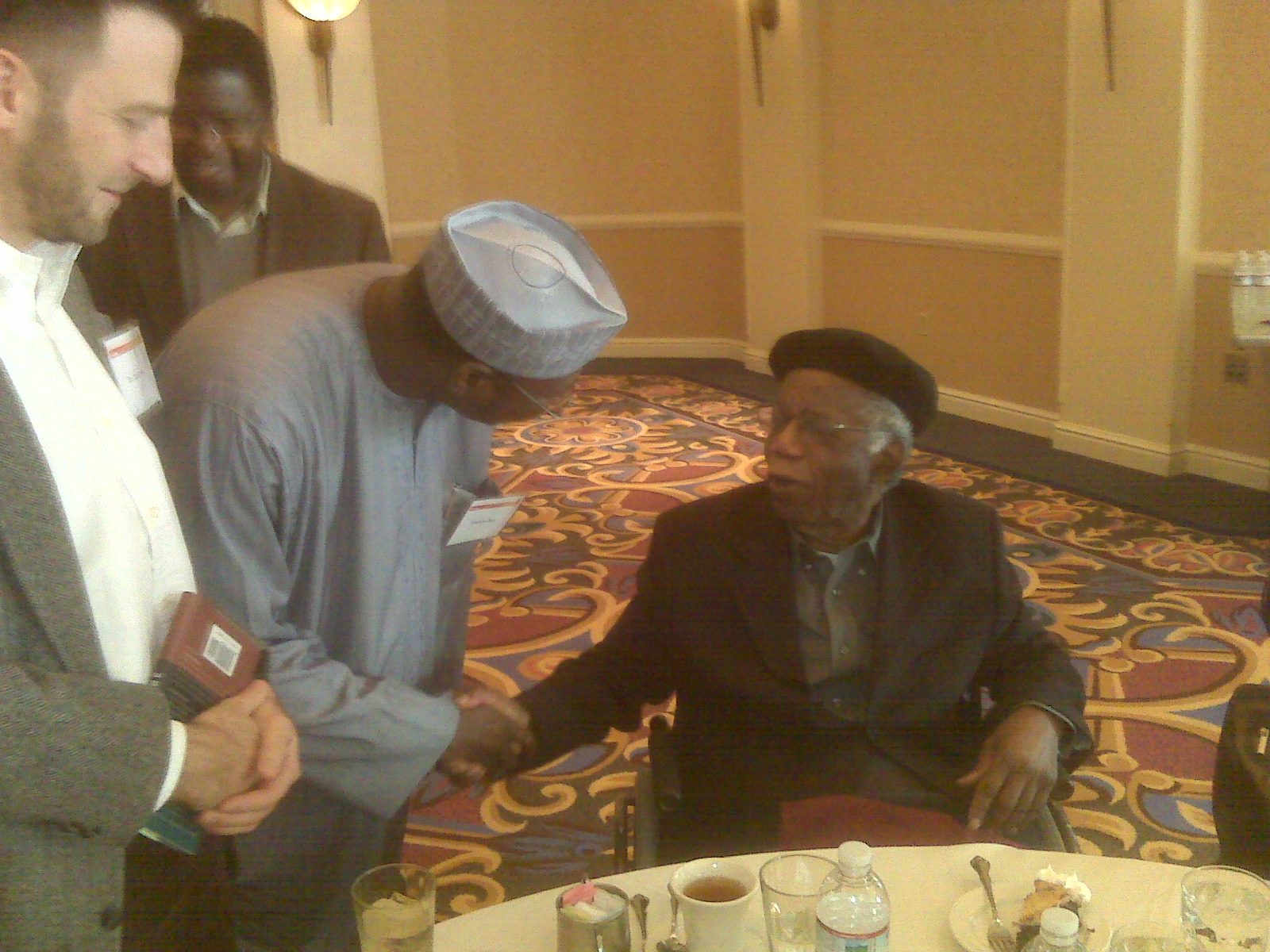
Carl LeVan discussing the elections with Chinua Achebe and INEC Commission Jega in December 2010
when President Obasanjo’s lawyers lobbied to have all elections on the same day, the courts this year ruled against legislators who sought to change the sequence of the elections. By affirming INEC’s authority to determine the sequence of elections, the courts challenged the PDP machinery yet again, undermining the ruling party’s efforts to maximize “coattail effects” by holding presidential elections before the legislative elections.
In the long run this will improve opposition opportunities – a fact apparently reaffirmed by PDP’s weak showing in the legislative elections held last weekend with the party losing ground in several key states across the country. For example:
- In Ogun state, the Obasanjo “brand name” was defeated in the hometown of the former president. The daughter of former President Olusegun Obasanjo, Iyabo Obasanjo-Bello, contested the Senatorial seat in Abeokuta in Ogun Central. She lost in her father’s Ita-Eko, Abeokuta Ward 11 to her Action Congress Nigeria (ACN) counterpart, Gbenga Obadara. While Obasanjo-Bello polled 85 votes, Obadara scored 194.
- Again in Ogun State, in Governor Gbenga Daniel’s Isote Ward in Sagamu, his PDP Senatorial candidate, Toheeb Odunowo lost to the ACN candidate, former deputy governor of the state, Gbenga Kaka by 121 votes to PDP’s 90 votes. (PPN scored 118 and Labour Party 27).
- In Kwara State, Ibrahim Yahaya Oloriegbe (ACN) defeated outgoing governor Bukola Sakari (PDP). In Osun State, Olagunsoye Oyinlola, the former governor of the PDP also lost to his ACN rival while controversial senator, Iyiola Omisore has also lost his seat in vote tallies released so far. See Sahara Reporters for a tally of other compelling results.
On the other hand, Muhammadu’s pre-election statement that he did not intend to use the courts should he lose, rang out as a threat that no longer seemed terribly veiled in the wake of the horrifying post-election violence earlier this week. He eventually condemned the violence, and reversed his pledge to not appeal the electoral results. Whether the courts can again serve as peaceful arbiters in general depends in part on the ultimate resolution of a bizarre set of decisions on recent electoral appeals – and flaws in the Electoral Act which will likely extend, rather than resolve, such animosities.
Legal Avenues for Electoral Appeals
The 2010 Electoral Act streamlines the appeals process and shifts some of the burden of evidence to plaintiffs in order to apparently reduce the number of frivolous complaints about electoral results. However it also provides little guidance on the critical questions related to tenure. If an incumbent’s election is challenged, who is in charge in the interim? And more broadly, how much authority do the courts have to decide such matters?
Two sections of the Electoral Act detail the civil procedure for appeals. First, Section 140 outlines the judicial procedure for bringing an electoral petition, stating:
- “If the Tribunal or the Court as the case may be, determines that a candidate who was returned as elected was not validly elected on any ground, the election will be nullified.”
- “Where an election tribunal or court nullifies an election on the ground that the person who obtained the highest votes at the election was not qualified to contest the election, they shall order a fresh election.”
- “If the Tribunal or the Court determines that a candidate who was returned as elected was not validly elected on the ground that he did not score the majority of valid votes they shall declare as elected the candidate who scored the highest number of valid votes cast at the election and satisfied the requirements of the Constitution and this Act.”
Next, Schedule 1(28) explains what occurs following the conclusion of appeal proceedings, stating that “At the conclusion of the hearing, the Tribunal shall determine whether a person whose election or return is complained of or any other person, and what person, was validly returned or elected, or whether the election was void.” In other words, election tribunals have clear authority to determine the winner of an election. At that point, “If the tribunal or court has determined that the election is invalid, then, subject to section 138, where there is an appeal that fails, a new election shall be held by the Commission.”
Though these provisions sound clear enough, the 2010 Electoral Act does not address how such judicial decisions would affect tenure. More importantly, the Federal High Court in April upheld a decision of a February Abuja High Court decision based on the 2006 Electoral Act (and considering Section 180 of the Constitution relating to tenure) challenged the authority of the courts to determine a winner.
Synchronizing Tenure, and Determining the Winner
This raises two sets of questions. The first concerns whether a governor who wins a seat after an electoral challenge will be required to run for re-election at the end of the electorally fixed four year term, or if the term of office begins only when the governor is sworn into office. This is important because with the PDP’s poor showing in the gubernatorial races, allowing governors to being their term when they take the oath has the effect of extending the tenure beyond the official fixed term — and thus conflicting with a fundamental feature of presidential political systems.
The other set of questions revolve around the status of an incumbent who decides to run for re-election. If an incumbent decides to run for re-election and the re-election is challenged, would the incumbent have a claim to continue in office until the election petition successfully removes him or her? The question is of particular importance when approached from a governance standpoint. Who is responsible for matters of state while the election petition is undergoing judicial review? If the seat is an open one with no incumbent, then it would make more sense for no one would be sworn in until the dispute is resolved. For Nigeria’s governors, who control billions of dollars in revenue received from the center, an extended absence of leadership would dramatically undermine governance.
The Electoral Act does not address these questions, which affect at least five sitting governors who are fighting to extend their tenure and whose cases may set legal precedent. None of the cases promise to simplify INEC’s task or to weaken PDP hegemony. Comments next week will analyze these cases and put them in the context of Nigeria’s recent constitutional amendments.